


Page 82 - sst_class_06
P. 82
Nature of work also causes discrimination. Certain kinds of work are valued more than
             others. For example, teaching is preferred to cutting hair, farming to picking garbage and
             carpentry to sweeping and cleaning. Activities like cutting hair, picking garbage, sweeping
             and cleaning are considered to be of inferior nature to the activities of teaching, farming

             and carpentry. And they are, therefore discriminated against caste based discrimination
             dominated the Indian social life for quite some time. The Indian social pyramid has the
             “upper caste” at its top and the ‘untouchables’ at its base. The top and the base truely
             reflect the numbers of people belonging to the two groups—upper caste and untouchables.
             Those who belong to upper caste regard themselves superior to those who are untouchables.
             In India of yesterday, the upper caste discriminated against the untouchables in every walk

             of life. Untouchables were not allowed to take up jobs other than low menial works. They
             were not permitted to enter houses, shops and temples where the upper caste had an
             access. In villages they were not allowed to take water from the village well. Even their
             children could not sit near the children of other castes in school. Most of all untouchables
             could not travel in a cart, tanga or bus carrying persons of other castes. This was indeed a
             cruel discrimination. Fortunately, it is going away and hopefully it will disappear from the
             Indian social life.
                                                    striving for equality

             Along with the struggle for freedom from British rule, people like Dalits, women, tribals
             and peasants also fought for equality. When India became an Independent nation in 1947,
             the framers of the Indian Constitution laid special emphasis to ensure that all the people
             of India are considered equal and to eradicate inequality.

             Constitutional Steps : In 1947, when India became a free nation, our leaders
             identified the different kinds of inequality that existed in our country.

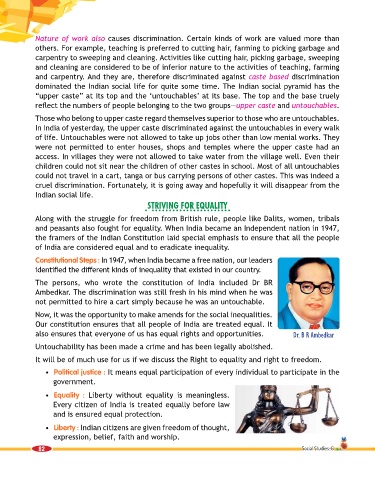
             The  persons,  who  wrote  the  constitution  of  India  included  Dr  BR
             Ambedkar. The discrimination was still fresh in his mind when he was
             not permitted to hire a cart simply because he was an untouchable.

             Now, it was the opportunity to make amends for the social inequalities.
             Our constitution ensures that all people of India are treated equal. It
             also ensures that everyone of us has equal rights and opportunities.                     Dr. B R Ambedkar

             Untouchability has been made a crime and has been legally abolished.
             It will be of much use for us if we discuss the Right to equality and right to freedom.

                 •   Political justice : It means equal participation of every individual to participate in the
                   government.

                 •   Equality : Liberty  without  equality  is meaningless.
                   Every citizen of India is treated equally before law
                   and is ensured equal protection.

                 •   Liberty : Indian citizens are given freedom of thought,
                   expression, belief, faith and worship.

              82                                                                                         Social Studies-6

