


Page 77 - sst_class_06
P. 77
Diversity in fooD habits


             Different food habits are seen in different regions of the country
             due to different climatic conditions and food availability.
             Wheat, pulses, milk are produced more in northern and western parts
             of India. So, dishes of these food grains are most popular in these
             regions, but people also eat rice and rice products like idli-dosa, etc.

             People of southern and eastern parts of the country like to eat
             rice, fish, coconut, sambhar-dosa, idli, etc.
             Groundnut, coconut and til oil are mostly used in western and
             southern India.

             Spices are the speciality of Indian food. People use cardamom, cloves, pepper, turmeric, chillies,
             etc. Spices make food tasty and aromatic. Rasogullas, sandesh, shrikhand, burfi, jalebis, ladoos
             are famous sweets of India. People eat these sweets in different parts of India.

                                             Diversity in festivals anD Dance

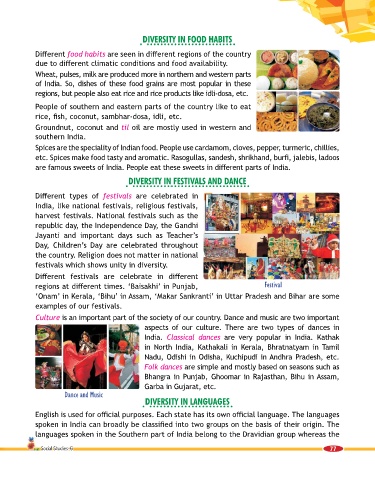
             Different  types  of  festivals are  celebrated in
             India, like national festivals, religious festivals,

             harvest festivals. National festivals such as the
             republic day, the Independence Day, the Gandhi
             Jayanti  and  important  days such as  Teacher’s
             Day,  Children’s  Day  are  celebrated  throughout
             the country. Religion does not matter in national
             festivals which shows unity in diversity.
             Different  festivals  are  celebrate  in  different

             regions at different times. ‘Baisakhi’ in Punjab,                              Festival
             ‘Onam’ in Kerala, ‘Bihu’ in Assam, ‘Makar Sankranti’ in Uttar Pradesh and Bihar are some
             examples of our festivals.
             Culture is an important part of the society of our country. Dance and music are two important

                                                   aspects of our culture. There are two types of dances in
                                                   India.  Classical dances  are  very  popular  in  India.  Kathak
                                                   in  North  India,  Kathakali  in  Kerala,  Bhratnatyam  in  Tamil
                                                   Nadu, Odishi in Odisha, Kuchipudi in Andhra Pradesh, etc.
                                                   Folk dances are simple and mostly based on seasons such as
                                                   Bhangra in Punjab, Ghoomar in Rajasthan, Bihu in Assam,
                                                   Garba in Gujarat, etc.
                       Dance and Music
                                                   Diversity in languages

             English is used for official purposes. Each state has its own official language. The languages
             spoken in India can broadly be classified into two groups on the basis of their origin. The

             languages spoken in the Southern part of India belong to the Dravidian group whereas the

               Social Studies-6                                                                                    77

