


Page 84 - sst_class_06
P. 84
laws provide Harijans with educational and vocational privileges and special representation
in the Indian Parliament.
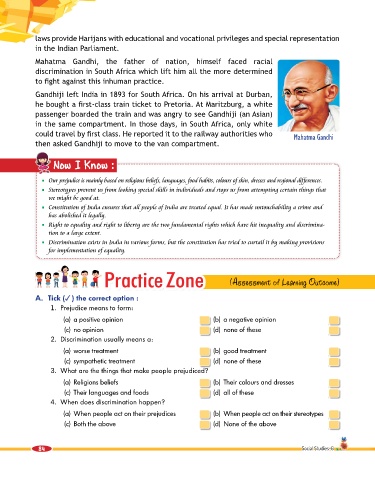
Mahatma Gandhi, the father of nation, himself faced racial
discrimination in South Africa which lift him all the more determined
to fight against this inhuman practice.
Gandhiji left India in 1893 for South Africa. On his arrival at Durban,
he bought a first-class train ticket to Pretoria. At Maritzburg, a white
passenger boarded the train and was angry to see Gandhiji (an Asian)
in the same compartment. In those days, in South Africa, only white
could travel by first class. He reported it to the railway authorities who Mahatma Gandhi
then asked Gandhiji to move to the van compartment.
Now I Know :
Our prejudice is mainly based on religious beliefs, languages, food habits, colours of skin, dresses and regional differences.
Stereotypes prevent us from looking special skills in individuals and stops us from attempting certain things that
we might be good at.
Constitution of India ensures that all people of India are treated equal. It has made untouchability a crime and
has abolished it legally.
Right to equality and right to liberty are the two fundamental rights which have hit inequality and discrimina-
tion to a large extent.
Discrimination exists in India in various forms, but the constitution has tried to curtail it by making provisions
for implementation of equality.
(Assessment of Learning Outcome)
A. Tick () the correct option :
1. Prejudice means to form:
(a) a positive opinion (b) a negative opinion
(c) no opinion (d) none of these
2. Discrimination usually means a:
(a) worse treatment (b) good treatment
(c) sympathetic treatment (d) none of these
3. What are the things that make people prejudiced?
(a) Religions beliefs (b) Their colours and dresses
(c) Their languages and foods (d) all of these
4. When does discrimination happen?
(a) When people act on their prejudices (b) When people act on their stereotypes
(c) Both the above (d) None of the above
84 Social Studies-6

