


Page 80 - sst_class_06
P. 80
Chapter  17           striviNg for eqUality


             In a country full of diversities, we often come across people, who look different from us,
             speak different languages, wear different types of clothes, have different food habits, etc.
             Their opinion, attitudes and thoughts may also be different. We find them strange and
             unfamiliar. When we do not understand them properly, we usually form a negative opinion
             about them which results in building up of prejudices.

                                                            PrejuDice

             Prejudice means to judge other people negatively or see them as an inferior. For example—we
             think English is the best language and we respect those who can converse well in English and
             look down upon people who cannot speak English. Even people of different religions, cultures,
             colours of their skin, clothes they wear, etc. are looked with suspicions. Another difference
             is visible through their economic background, which further adds to their inequality. People

             who are poor do not have the resources or money to meet their basic needs of food, clothing
             and shelter often face discrimination in offices, hospitals, schools, etc.

                                                          stereotyPes
             Prejudice  or  pre-conceived  idea  leads  to  the  creation  of  stereotypes. If we generalise
             all people of a particular group into one image, we create a stereotype. Here are some
             examples or statements that we hear frequently. For instance—

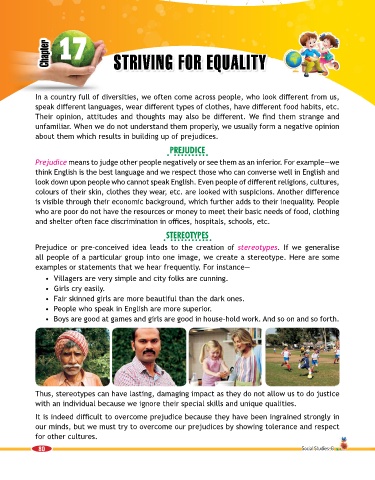
                 •   Villagers are very simple and city folks are cunning.
                 •   Girls cry easily.
                 •   Fair skinned girls are more beautiful than the dark ones.

                 •   People who speak in English are more superior.
                 •   Boys are good at games and girls are good in house-hold work. And so on and so forth.


             Thus, stereotypes can have lasting, damaging impact as they do not allow us to do justice
             with an individual because we ignore their special skills and unique qualities.

             It is indeed difficult to overcome prejudice because they have been ingrained strongly in
             our minds, but we must try to overcome our prejudices by showing tolerance and respect
             for other cultures.

              80                                                                                         Social Studies-6

