


Page 43 - sst_class_06
P. 43
the archaeologists have labelled as the priest king. So did the priests play an important
role in administering the city. A variety of tasks such as regulation of trade, collection of
taxes and maintenance of law and order was looked after by administration.
relIgIon
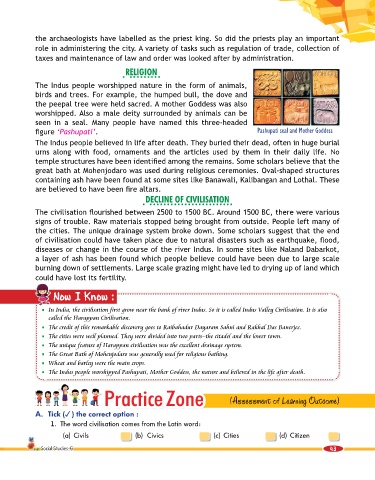
The Indus people worshipped nature in the form of animals,
birds and trees. For example, the humped bull, the dove and
the peepal tree were held sacred. A mother Goddess was also
worshipped. Also a male deity surrounded by animals can be
seen in a seal. Many people have named this three-headed
figure ‘Pashupati’. Pashupati seal and Mother Goddess
The Indus people believed in life after death. They buried their dead, often in huge burial
urns along with food, ornaments and the articles used by them in their daily life. No
temple structures have been identified among the remains. Some scholars believe that the
great bath at Mohenjodaro was used during religious ceremonies. Oval-shaped structures
containing ash have been found at some sites like Banawali, Kalibangan and Lothal. These
are believed to have been fire altars.
declIne of cIVIlIsatIon
The civilisation flourished between 2500 to 1500 BC. Around 1500 BC, there were various
signs of trouble. Raw materials stopped being brought from outside. People left many of
the cities. The unique drainage system broke down. Some scholars suggest that the end
of civilisation could have taken place due to natural disasters such as earthquake, flood,
diseases or change in the course of the river Indus. In some sites like Naland Dabarkot,
a layer of ash has been found which people believe could have been due to large scale
burning down of settlements. Large scale grazing might have led to drying up of land which
could have lost its fertility.
Now I Know :
In India, the civilisation first grow near the bank of river Indus. So it is called Indus Valley Civilisation. It is also
called the Harappan Civilisation.
The credit of this remarkable discovery goes to Raibahadur Dayaram Sahni and Rakhal Das Banerjee.
The cities were well planned. They were divided into two parts–the citadel and the lower town.
The unique feature of Harappan civilisation was the excellent drainage system.
The Great Bath of Mohenjodaro was generally used for religious bathing.
Wheat and barley were the main crops.
The Indus people worshipped Pashupati, Mother Goddess, the nature and believed in the life after death.
(Assessment of Learning Outcome)
A. Tick () the correct option :
1. The word civilisation comes from the Latin word:
(a) Civils (b) Civics (c) Cities (d) Citizen
Social Studies-6 43

