


Page 47 - sst_class_06
P. 47
relIgIon
In the beginning, the Aryans worshipped the forces of nature such as Prithvi (Earth), Agni
(fire), Surya (Sun), Indra (rain), Vayu (wind) and Varun (sky). The Aryans offered prayers and
sacrifices. Initially, there were very few rituals. But as the Aryans settled down, offerings
and sacrifices became elaborate, complex and expensive. Now new Gods like Brahma as the
creator of the universe, Vishnu as the preserver and Shiva as the destroyer became prominent.
Sacrifice assumed great importance and religious worship became very complex.
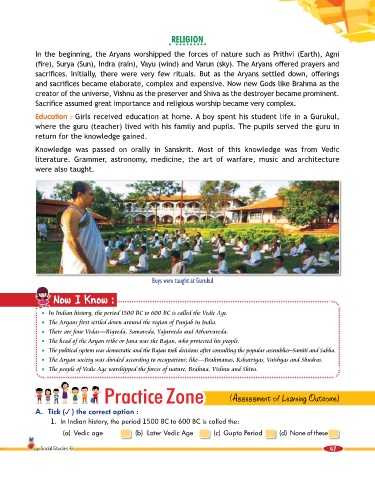
Education : Girls received education at home. A boy spent his student life in a Gurukul,
where the guru (teacher) lived with his family and pupils. The pupils served the guru in
return for the knowledge gained.
Knowledge was passed on orally in Sanskrit. Most of this knowledge was from Vedic
literature. Grammer, astronomy, medicine, the art of warfare, music and architecture
were also taught.
Boys were taught at Gurukul
Now I Know :
In Indian history, the period 1500 BC to 600 BC is called the Vedic Age.
The Aryans first settled down around the region of Punjab in India.
There are four Vedas—Rigveda, Samaveda, Yajurveda and Atharvaveda.
The head of the Aryan tribe or Jana was the Rajan, who protected his people.
The political system was democratic and the Rajan took decisions after consulting the popular assemblies–Samiti and Sabha.
The Aryan society was divided according to occupations; like—Brahmanas, Kshatriyas, Vaishyas and Shudras.
The people of Vedic Age worshipped the forces of nature, Brahma, Vishnu and Shiva.
(Assessment of Learning Outcome)
A. Tick () the correct option :
1. In Indian history, the period 1500 BC to 600 BC is called the:
(a) Vedic age (b) Later Vedic Age (c) Gupta Period (d) None of these
Social Studies-6 47

