


Page 42 - sst_class_06
P. 42
fire  altars,  the  Great  Bath  of  Mohenjodaro.  Most  probably  the  ruling  class  lived  in  the
             Citadel. The lower town contained the houses and workplaces of the common people. In the
             lower town, all the houses were connected directly to the well planned drainage system of
             covered drains and soak pits.

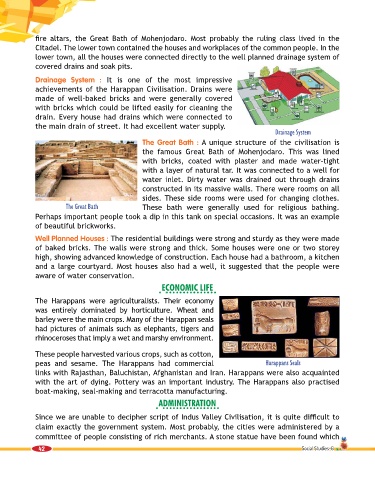
             Drainage System : It is one of the most impressive
             achievements of the Harappan Civilisation. Drains were
             made of well-baked bricks and were generally covered
             with bricks which could be lifted easily for cleaning the
             drain. Every house had drains which were connected to
             the main drain of street. It had excellent water supply.
                                                                                                Drainage System
                                                  The Great Bath : A unique  structure  of the civilisation  is
                                                  the  famous Great  Bath  of  Mohenjodaro.  This was lined
                                                  with  bricks,  coated  with  plaster  and  made  water-tight
                                                  with a layer of natural tar. It was connected to a well for
                                                  water  inlet.  Dirty  water  was drained  out through  drains
                                                  constructed in its massive walls. There were rooms on all
                                                  sides. These side rooms were used for changing clothes.
                        The Great Bath            These  bath were  generally  used  for  religious bathing.
             Perhaps important people took a dip in this tank on special occasions. It was an example
             of beautiful brickworks.
             Well Planned Houses : The residential buildings were strong and sturdy as they were made
             of baked bricks. The walls were strong and thick. Some houses were one or two storey
             high, showing advanced knowledge of construction. Each house had a bathroom, a kitchen
             and a large courtyard. Most houses also had a well, it suggested that the people were
             aware of water conservation.

                                                         economIc lIfe

             The Harappans were agriculturalists.  Their economy
             was entirely dominated by horticulture. Wheat and
             barley were the main crops. Many of the Harappan seals
             had pictures of animals such as elephants, tigers and
             rhinoceroses that imply a wet and marshy environment.

             These people harvested various crops, such as cotton,
             peas  and  sesame.  The  Harappans  had  commercial                             Harappans Seals
             links with Rajasthan, Baluchistan, Afghanistan and Iran. Harappans were also acquainted
             with the art of dying. Pottery was an important industry. The Harappans also practised
             boat-making, seal-making and terracotta manufacturing.

                                                        admInIstratIon

             Since we are unable to decipher script of Indus Valley Civilisation, it is quite difficult to
             claim exactly the government system. Most probably, the cities were administered by a
             committee of people consisting of rich merchants. A stone statue have been found which

              42                                                                                         Social Studies-6

