


Page 41 - sst_class_06
P. 41
chapter  8            THe eaRlIeST cITIeS Of


                                        THe INdIaN SUbcONTIeNT


             As early man started producing food, he began to lead a semi-settled life. The first villages
             were  naturally  set  up in the  fertile  river-valleys.  Then  man  learnt  the  use  of  metals,
             like copper and Bronze. Better tools and fertile lands led to surplus production of food-
             grains. So some people could leave food production and shift to other craft and trade. The
             exchange of goods led to the growth of trade and trade centres. The trade centres where
             a large number of people settled developed into cities.
             Civilisation : The word ‘Civilisation’ comes from the Latin word ‘Civics’, meaning citizen. City
             life requires administrative bodies, language, script and forms of organised worship and cultural
             expression. The sum of such aspects of organised life in a society is called civilisation.

             The earliest cities of the Indian subcontinent came up in the North-West in the region
             drained by the river Indus and its tributaries. About 4500 years ago, a great civilisation
             flourished in this region.
                                                  Indus Valley cIVIlIsatIon

             In India, the first developed cities were found in the valley of
             river Indus (also called Sindhu). So it was named Indus Valley
             Civilisation. It  is also called  the  Harappan  Civilisation as
             Harappa was the first site of this civilisation to be excavated.
             The  ancient  civilisation  included  urban  centres  such  as
             Kalibangan, Dholavira, Rupar, Lothal, Rakhigarhi in modern
             day India and Harappa, Ganweriwala, Mohenjodaro in modern
             day Pakistan. Lothal was the only city with dockyard facility.
             The Indus  Valley  Civilisation  included  most of  Pakistan,
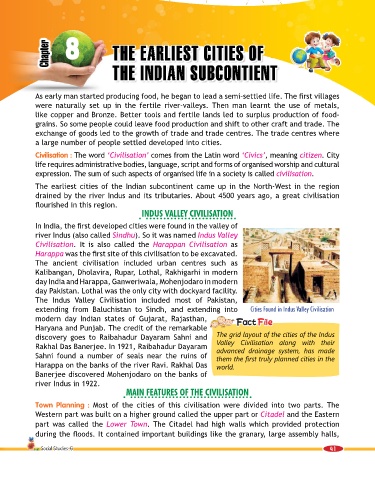
             extending  from  Baluchistan  to Sindh,  and  extending  into              Cities Found in Indus Valley Civilisation
             modern  day  Indian  states  of Gujarat,  Rajasthan,
             Haryana and Punjab. The credit of the remarkable
             discovery goes to Raibahadur  Dayaram  Sahni  and              The grid layout of the cities of the Indus
             Rakhal Das Banerjee. In 1921, Raibahadur Dayaram               Valley Civilisation along with their
                                                                            advanced drainage system, has made
             Sahni  found a  number of seals  near  the  ruins  of          them the first truly planned cities in the
             Harappa on the banks of the river Ravi. Rakhal Das             world.
             Banerjee discovered Mohenjodaro on the banks of
             river Indus in 1922.
                                             maIn features of tHe cIVIlIsatIon

             Town Planning : Most of the cities of this civilisation were divided into two parts. The
             Western part was built on a higher ground called the upper part or Citadel and the Eastern
             part was called the Lower Town. The Citadel had high walls which provided protection
             during the floods. It contained important buildings like the granary, large assembly halls,


               Social Studies-6                                                                                    41

