


Page 81 - sst_class_04
P. 81
Communication: Communication is an exchange of information between two people

             or a group of persons. To give information to exchange of thoughts, messages,
             speech, visuals, writing or behaviour is also called communication.


             Communication can be oral, written or non-verbal, such as body language and
             facial expressions.

             There are several ways  of  sending  messages.

             We can send a letter or telegram to a friend talk

             to him over the phone, or send an e-mail. Long
             ago,  people  sent  messages  through  carrier
             pigeons  or had  to  send someone  with  the

             message. However, we now have more reliable

             and faster methods of sending messages. Let us
             read about a few of them.

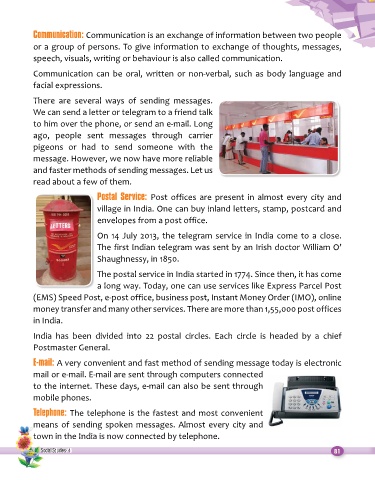
                                   Postal  Service:  Post offices are present in almost every city and

                                   village in India. One can buy inland letters, stamp, postcard and
                                   envelopes from a post office.


                                   On 14 July 2013, the telegram service in India come to a close.
                                   The first Indian telegram was sent by an Irish doctor William O’

                                   Shaughnessy, in 1850.

                                   The postal service in India started in 1774. Since then, it has come
                                   a long way. Today, one can use services like Express Parcel Post

             (EMS) Speed Post, e-post office, business post, Instant Money Order (IMO), online
             money transfer and many other services. There are more than 1,55,000 post offices

             in India.

             India has  been  divided  into  22 postal  circles. Each  circle is headed by  a chief

             Postmaster General.

             E-mail: A very convenient and fast method of sending message today is electronic

             mail or e-mail. E-mail are sent through computers connected
             to the internet. These days, e-mail can also be sent through
             mobile phones.


             Telephone: The telephone is the fastest and most convenient
             means of sending spoken messages. Almost every city and

             town in the India is now connected by telephone.

               Social Studies-4                                                                                     81

