


Page 68 - sst_class_04
P. 68
Conservation of Forest and Wildlife


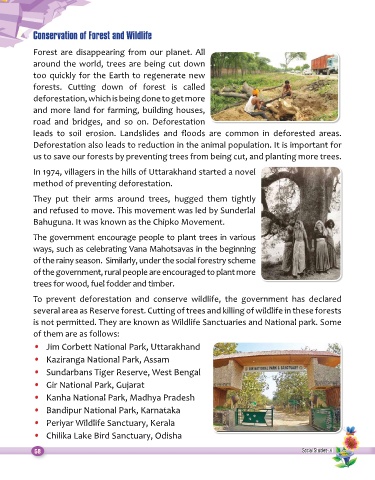
             Forest are disappearing from our planet. All
             around the world, trees are being cut down

             too quickly for the Earth to regenerate new

             forests. Cutting  down  of  forest is called
             deforestation, which is being done to get more
             and more land for farming, building houses,

             road and bridges, and so on.  Deforestation

             leads to  soil  erosion.  Landslides  and  floods  are common  in  deforested areas.
             Deforestation also leads to reduction in the animal population. It is important for
             us to save our forests by preventing trees from being cut, and planting more trees.


             In 1974, villagers in the hills of Uttarakhand started a novel
             method of preventing deforestation.


             They  put  their  arms  around  trees, hugged  them  tightly
             and refused to move. This movement was led by Sunderlal

             Bahuguna. It was known as the Chipko Movement.

             The government encourage people to plant trees in various
             ways, such as celebrating Vana Mahotsavas in the beginning

             of the rainy season.  Similarly, under the social forestry scheme
             of the government, rural people are encouraged to plant more

             trees for wood, fuel fodder and timber.

             To prevent deforestation  and conserve wildlife, the government  has  declared

             several area as Reserve forest. Cutting of trees and killing of wildlife in these forests
             is not permitted. They are known as Wildlife Sanctuaries and National park. Some

             of them are as follows:

             •  Jim Corbett National Park, Uttarakhand
             •  Kaziranga National Park, Assam

             •  Sundarbans Tiger Reserve, West Bengal

             •  Gir National Park, Gujarat
             •  Kanha National Park, Madhya Pradesh

             •  Bandipur National Park, Karnataka

             •  Periyar Wildlife Sanctuary, Kerala

             •  Chilika Lake Bird Sanctuary, Odisha


             68                                                                                          Social Studies-4

