


Page 51 - sst_class_07
P. 51
RashtRakutas
             The Rashtrakutas were the descendants of the feudatory chiefs, the Satavahanas. They
             rose to power in the 8th century under Dantidurga. He laid

             the foundation of the dynasty in 753 AD after defeating the
             Chalukyas of Badami. He made Malkhed, which is a region in
             the present day Maharashtra, as his capital.

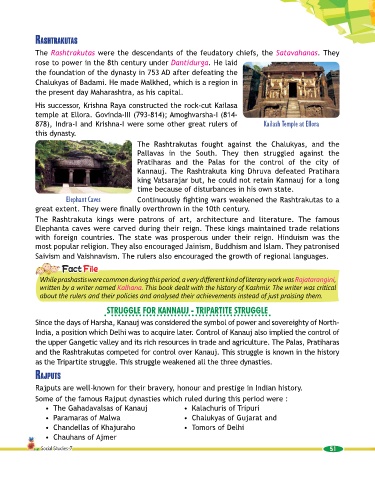
             His successor, Krishna Raya constructed the rock-cut Kailasa
             temple at Ellora. Govinda-III (793-814); Amoghvarsha-I (814-
             878), Indra-I and Krishna-I were some other great rulers of                    Kailash Temple at Ellora
             this dynasty.
                                                The Rashtrakutas  fought against  the  Chalukyas,  and  the
                                                Pallavas  in  the  South.  They  then  struggled  against  the
                                                Pratiharas  and  the  Palas  for  the  control of  the  city  of
                                                Kannauj.  The  Rashtrakuta  king  Dhruva  defeated  Pratihara
                                                king Vatsarajar but, he could not retain Kannauj for a long
                                                time because of disturbances in his own state.
                        Elephant Caves          Continuously fighting wars weakened the Rashtrakutas to a
             great extent. They were finally overthrown in the 10th century.
             The Rashtrakuta  kings were patrons of  art, architecture  and  literature.  The famous
             Elephanta caves were carved during their reign. These kings maintained trade relations
             with  foreign  countries.  The  state  was  prosperous under  their  reign.  Hinduism  was  the
             most popular religion. They also encouraged Jainism, Buddhism and Islam. They patronised
             Saivism and Vaishnavism. The rulers also encouraged the growth of regional languages.


               While prashastis were common during this period, a very different kind of literary work was Rajatarangini,
               written by a writer named Kalhana. This book dealt with the history of Kashmir. The writer was critical
               about the rulers and their policies and analysed their achievements instead of just praising them.

                                      sTruggle fOr Kannauj - TriParTiTe sTruggle
             Since the days of Harsha, Kanauj was considered the symbol of power and sovereighty of North-

             India, a position which Delhi was to acquire later. Control of Kanauj also implied the control of
             the upper Gangetic valley and its rich resources in trade and agriculture. The Palas, Pratiharas
             and the Rashtrakutas competed for control over Kanauj. This struggle is known in the history
             as the Tripartite struggle. This struggle weakened all the three dynasties.

             RajPuts

             Rajputs are well-known for their bravery, honour and prestige in Indian history.
             Some of the famous Rajput dynasties which ruled during this period were :
                 •  The Gahadavalsas of Kanauj                   •  Kalachuris of Tripuri
                 •  Paramaras of Malwa                           •  Chalukyas of Gujarat and
                 •  Chandellas of Khajuraho                      •  Tomors of Delhi
                 •  Chauhans of Ajmer

               Social Studies-7                                                                                    51

