


Page 12 - sst_class_07
P. 12
mountains and the foothills of the Himalayas and the Sundarbans delta are the main features

             of this basin. The delta has been named as Sundarbans after the Sundari tree which grows
             abundantly in the region.

             climatE

             The  Ganga-Brahmaputra  basin  experiences  the  monsoon types  of  climate.  It  has  hot
             summers and cold winters. It gains rainfall from mid June to mid September.

             Natural vEgEtatioN

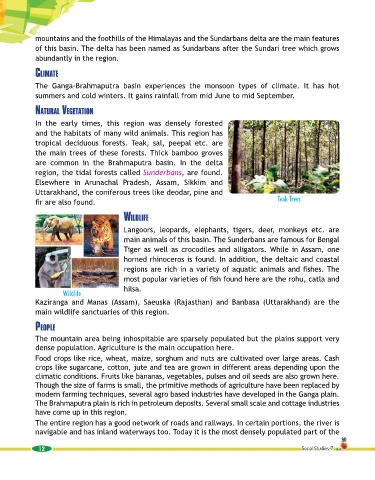
             In  the early  times,  this  region  was  densely  forested
             and the habitats of many wild animals. This region has
             tropical deciduous  forests.  Teak,  sal, peepal etc.  are
             the main trees of these forests. Thick bamboo groves
             are common in the  Brahmaputra  basin.  In the  delta
             region, the tidal forests called Sunderbans, are found.
             Elsewhere  in  Arunachal Pradesh,  Assam, Sikkim  and
             Uttarakhand, the coniferous trees like deodar, pine and

             fir are also found.                                                                 Teak Trees

                                            WildlifE
                                            Langoors, leopards, elephants, tigers, deer, monkeys etc. are

                                            main animals of this basin. The Sunderbans are famous for Bengal
                                            Tiger as well as crocodiles and alligators. While in Assam, one
                                            horned rhinoceros is found. In addition, the deltaic and coastal
                                            regions are rich in a variety of aquatic animals and fishes. The
                                            most popular varieties of fish found here are the rohu, catla and
                                            hilsa.
                       Wildlife
             Kaziranga and Manas  (Assam), Saeuska  (Rajasthan)  and  Banbasa  (Uttarakhand)  are the
             main wildlife sanctuaries of this region.


             pEoplE
             The mountain area being inhospitable are sparsely populated but the plains support very
             dense population. Agriculture is the main occupation here.
             Food crops like rice, wheat, maize, sorghum and nuts are cultivated over large areas. Cash
             crops like sugarcane, cotton, jute and tea are grown in different areas depending upon the
             climatic conditions. Fruits like bananas, vegetables, pulses and oil seeds are also grown here.
             Though the size of farms is small, the primitive methods of agriculture have been replaced by
             modern farming techniques, several agro based industries have developed in the Ganga plain.
             The Brahmaputra plain is rich in petroleum deposits. Several small scale and cottage industries
             have come up in this region.
             The entire region has a good network of roads and railways. In certain portions, the river is
             navigable and has inland waterways too. Today it is the most densely populated part of the


                                                                                                         Social Studies
              12
              12                                                                                         Social Studies-7-7

