


Page 11 - sst_class_07
P. 11
sunlight from reaching the ground. The interior of these forests are therefore dark and

             damp which promotes growth of climbers and ferns also with tall trees. the main trees
             are Ebony, Mahogany, Rosewood, Rubber, Cinchona which are hardwood trees. Balsa, the
             lightest wood is also found in these forests. The forests yield a variety of products ranging
             from rubber, nuts, gum, resins to quinine which is a drug used to cure malaria.

             WildlifE

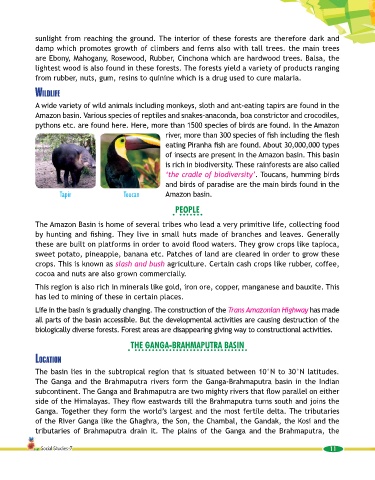
             A wide variety of wild animals including monkeys, sloth and ant-eating tapirs are found in the
             Amazon basin. Various species of reptiles and snakes–anaconda, boa constrictor and crocodiles,
             pythons etc. are found here. Here, more than 1500 species of birds are found. In the Amazon
                                                          river, more than 300 species of fish including the flesh
                                                          eating Piranha fish are found. About 30,000,000 types
                                                          of insects are present in the Amazon basin. This basin
                                                          is rich in biodiversity. These rainforests are also called

                                                          ‘the cradle of biodiversity’. Toucans, humming birds
                                                          and birds of paradise are the main birds found in the
                      Tapir                 Toucan        Amazon basin.

                                                              pEoplE

             The Amazon Basin is home of several tribes who lead a very primitive life, collecting food

             by hunting and fishing. They live in small huts made of branches and leaves. Generally
             these are built on platforms in order to avoid flood waters. They grow crops like tapioca,
             sweet potato, pineapple, banana etc. Patches of land are cleared in order to grow these
             crops. This is known as slash and bush agriculture. Certain cash crops like rubber, coffee,
             cocoa and nuts are also grown commercially.

             This region is also rich in minerals like gold, iron ore, copper, manganese and bauxite. This
             has led to mining of these in certain places.

             Life in the basin is gradually changing. The construction of the Trans Amazonian Highway has made
             all parts of the basin accessible. But the developmental activities are causing destruction of the
             biologically diverse forests. Forest areas are disappearing giving way to constructional activities.

                                              thE GanGa-Brahmaputra Basin

             locatioN

             The basin lies in the subtropical region that is situated between 10°N to 30°N latitudes.
             The Ganga and the Brahmaputra rivers form the Ganga-Brahmaputra basin in the Indian
             subcontinent. The Ganga and Brahmaputra are two mighty rivers that flow parallel on either

             side of the Himalayas. They flow eastwards till the Brahmaputra turns south and joins the
             Ganga. Together they form the world’s largest and the most fertile delta. The tributaries
             of the River Ganga like the Ghaghra, the Son, the Chambal, the Gandak, the Kosi and the
             tributaries of Brahmaputra drain it.  The plains of the Ganga and the Brahmaputra, the


               Social Studies-7                                                                                    11

