


Page 111 - sst_class_07
P. 111
country has a well structured 3-tier public health infrastructures comprising community Health

             Care Centres, Primary Health Centres and Sub-centres spread across rural and semi urban areas
             and tertiary medical care providing multi-speciality hospitals and medical colleges located
             almost exclusively in the urban areas.
             Medical tourists come in huge number to India every year. Medical tourists are the foreigners

             who  visit  any  country  specifically  for  medical  treatment  at  hospitals  offer  world  class
             facilities at a lower cost than what they would get in their own countries.

             Not just that, India is the fourth largest producer and exporter of medicines too.
             India’s rural health care system is in crisis because most of the doctors prefer the comfortable

             wealthy urban lives. Indian doctors settle in western countries for greater professional
             opportunities and better material. Even if some join rural areas their number is very less.
             Therefore, a large number of people living in the rural areas die due to inadequate medical
             treatment and facilities. Half of all children in India do not get adequate food to eat and
             are undernourished. Other reasons for unequal access to medical care in India are lack of
             financial resources and sound health care services in all rural area.

             Public anD PrivatE hEalth carE sErvicEs

             The health of a nation is difficult to define in terms of a single set of measures. At best,
             we can assess the health of the population by taking into account indicators like infant
             mortality  and maternal mortality  rates,  life expectancy  and  nutrition,  along with  the

             incidence of communicable and non-communicable diseases.
             Health care facilities can be divided into public and private health services.


             Public hEalth sErvicEs
             These are the hospitals which are run by the government. All these hospitals works as a
             chain and provide treatment both in rural and urban areas.

             The care and treatment varies from common problems to the
             special services. In villages, there are Primary Health Centres
             which have a trained nurse and a village health worker.

             Primary Health Centres (PHC) cater to many villagers in rural
             India. There is a District Hospital at the District level.

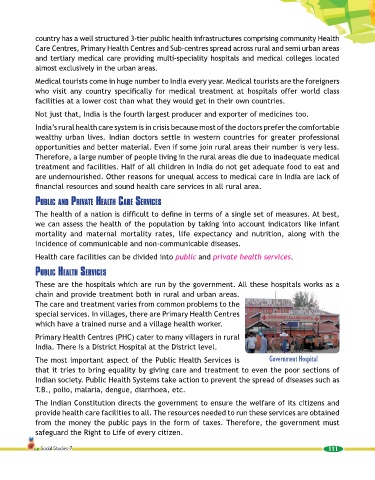
             The most important aspect of the Public Health Services is                       Government Hospital
             that it tries to bring equality by giving care and treatment to even the poor sections of
             Indian society. Public Health Systems take action to prevent the spread of diseases such as
             T.B., polio, malaria, dengue, diarrhoea, etc.

             The Indian Constitution directs the government to ensure the welfare of its citizens and
             provide health care facilities to all. The resources needed to run these services are obtained
             from the money the public pays in the form of taxes. Therefore, the government must
             safeguard the Right to Life of every citizen.


               Social Studies-7                                                                                   111

