


Page 99 - sst_class_04
P. 99
15                      Our Rights and


                                                                                                 Duties


                             Constitution of India
                             Fundamental Rights and Duties

                             Importance of Directive Principles


            Constitution of India


            The constitution of India tells us how the country should be
            governed. It is the longest written constitution in the world.

            It includes the method, powers and duties which must be
            followed by the government institution. It also describe the

            right and duties of citizens.

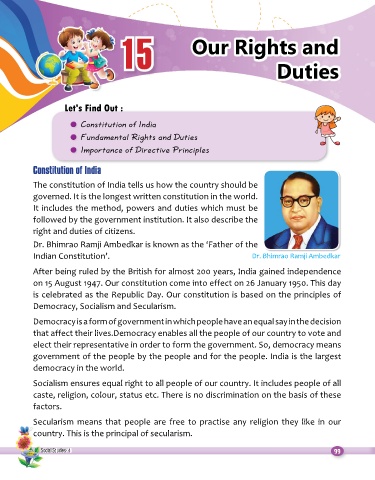
            Dr. Bhimrao Ramji Ambedkar is known as the ‘Father of the
            Indian Constitution’.                                                       Dr. Bhimrao Ramji Ambedkar

            After being ruled by the British for almost 200 years, India gained independence

            on 15 August 1947. Our constitution come into effect on 26 January 1950. This day
            is celebrated as the Republic Day. Our constitution is based on the principles of

            Democracy, Socialism and Secularism.

            Democracy is a form of government in which people have an equal say in the decision

            that affect their lives.Democracy enables all the people of our country to vote and
            elect their representative in order to form the government. So, democracy means

            government of the people by the people and for the people. India is the largest
            democracy in the world.

            Socialism ensures equal right to all people of our country. It includes people of all

            caste, religion, colour, status etc. There is no discrimination on the basis of these
            factors.


            Secularism means  that  people  are free to practise  any  religion they  like in  our
            country. This is the principal of secularism.


               Social Studies-4                                                                                     99

