


Page 91 - sst_class_06
P. 91
Chapter  19            rUral livelihoods


             Any work that is done to earn money to live, is called a means of livelihood. Different

             people  have  different  means  of  livelihood,  depending  on—where  they  live,  what  skills
             they develop and what kind of education they receives. Let us now see, what means of
             livelihood are available to people living in the rural areas in our country.

             They are classified into three categories :

               1.  Primary occupations, which relate to agriculture and farming and animal husbandry.
               2.  Secondary occupations, which are related to manufacturing units, self-employment, etc.

               3.  Tertiary occupation, which are service providing jobs like transport, communication,
                   banking, etc.

                                     occuPations anD Professions in rural areas

             The villagers of India are involved in their basic occupation—agriculture. Though earlier, there
             used to be primitive methods of carrying on this process; but nowadays, due to innovative
             methods, farmers are able to grow wheat, rice, lentils, vegetables, fruits and many other crops

             in order to accomplish the challenging task of feeding them, families and the nation.
             The farmers, based on the area of land possess, have been classified into four sections:

               1.   Landless Farmers : Some farmers do not have their own land for agriculture. They
                   work on the land of other persons. Some of them take land on lease and some of them
                   work on daily wage basis.

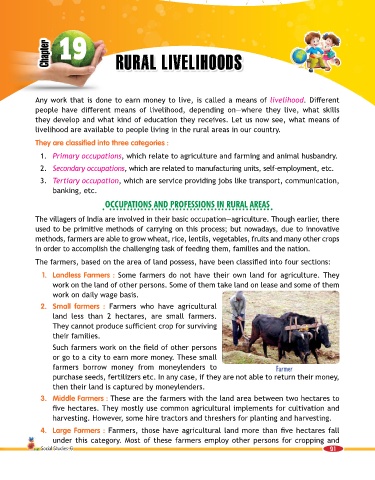
               2.   Small  farmers :  Farmers  who  have  agricultural
                   land  less  than  2  hectares,  are  small  farmers.
                   They cannot produce sufficient crop for surviving
                   their families.

                   Such farmers work on the field of other persons
                   or go to a city to earn more money. These small
                   farmers  borrow  money from  moneylenders  to                                Farmer
                   purchase seeds, fertilizers etc. In any case, if they are not able to return their money,
                   then their land is captured by moneylenders.

               3.   Middle Farmers : These are the farmers with the land area between two hectares to
                   five hectares. They mostly use common agricultural implements for cultivation and
                   harvesting. However, some hire tractors and threshers for planting and harvesting.

               4.   Large Farmers : Farmers, those have agricultural land more than five hectares fall
                   under this category. Most of these farmers employ other persons for cropping and
               Social Studies-6                                                                                    91

